TINTA is a self-initiated concept demo, not a real commission: a fictional curatorial space for a works-on-paper gallery in Madrid. I built it to show how far the studio goes when there's no client brake — not for an existing business.
TINTA isn’t a commission: it’s a self-initiated concept demo. A fictional curatorial space for a gallery of works on paper in Madrid, built with no client brakes to show how far the studio goes when no one says "not that". The goal wasn’t to sell: it was to prove technical ceiling and art direction.
The bet: treat a free exercise with the rigour of a real commission. Set a strict curatorial criterion and use it to measure every technical decision — if an effect doesn't serve the work on show, it goes. Freedom as discipline, not whim.
- Concept demo
- No client brake
- Digital sumi-e
- Technical ceiling
- Concept
A gallery that doesn’t exist
I invented the whole gallery — name, identity, curatorial criteria — to get a free field where I could push the technique without the constraints of a real project.
- Art direction
Digital sumi-e and hanko seal
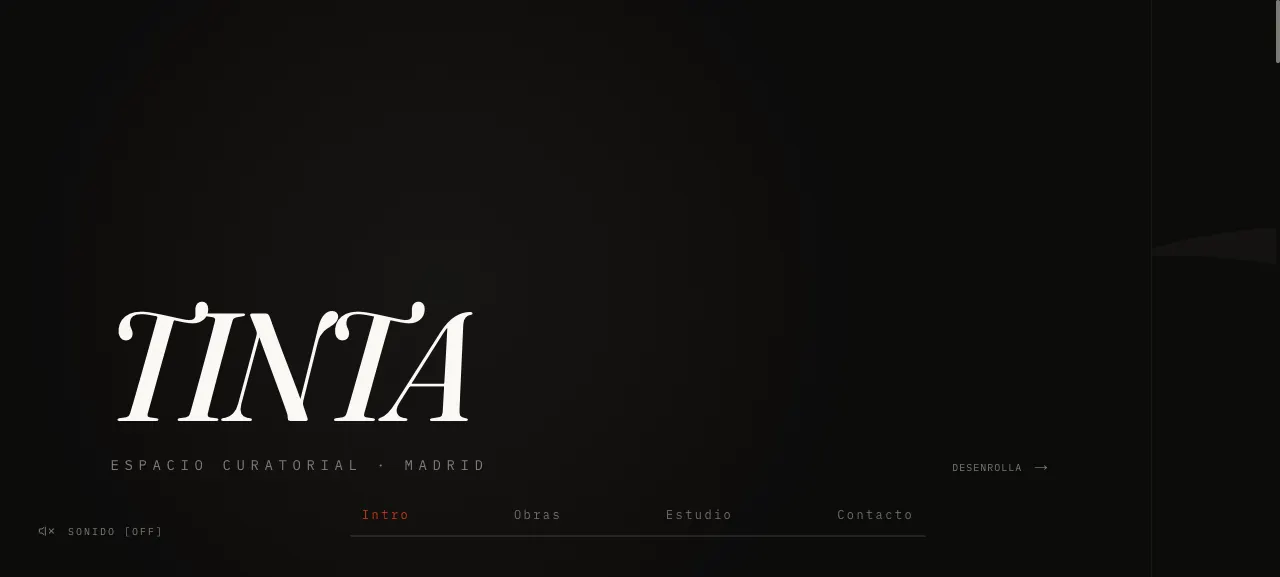
I borrowed the aesthetic of Japanese ink: a sumi-black background, bone paper, a single hanko-seal vermilion. The hero is liquid ink in WebGL that reacts in real time.
- System
Editorial over black
Fraunces for the expository, IBM Plex Mono for the artwork data. A strict editorial grid over sumi black, with the vermilion as the only point of tension.
- Build
WebGL and View Transitions
I built the reactive ink hero and shared-element transitions with the View Transitions API between one work and the next. A demonstration piece: visible technique, no client compromises.
Coded a real-time sumi-e ink WebGL hero, shared-element transitions via the View Transitions API, and an editorial grid on a sumi-black canvas with a vermilion hanko seal. A technical and art-direction showcase piece.
The system translates Japanese ink to the screen. Sumi black as background, bone paper for text, and a single hanko-seal vermilion as all the chromatic tension. Less is more, taken to the expository extreme.
- Sumi black background: the paper and the work are the light.
- A single vermilion: the hanko seal concentrates all the tension.
- Fraunces to exhibit, mono to catalogue: two registers, zero noise.
- WebGL in service of the concept, not the spectacle.
A concept only proves itself if the technique shows where it matters. These are the points where TINTA shows the studio's ceiling.
- 01 · WebGL ink hero
Liquid sumi-e ink reacting in real time: the first screen is already the technical demonstration.
- 02 · Transition between works
Shared-element View Transitions API links one work to the next like a curatorial pass, no cuts.
- 03 · Expository grid
Fraunces to exhibit, IBM Plex Mono for artwork data, over sumi black — two registers, zero noise.
- 04 · Hanko seal
A single vermilion concentrates all the chromatic tension, like the red seal over black ink.
TINTA serves its real purpose: to show the studio’s ceiling without a client’s concessions. A reactive sumi-e ink hero, View Transitions between works, and an art direction that asks no permission. It didn’t sell a painting — that was never the point. It sold capability.
With no client to hold it back, a demo shows what a commission hides: how far the studio can go.